

Dear Ezra Klein
A warning about cultural surrender

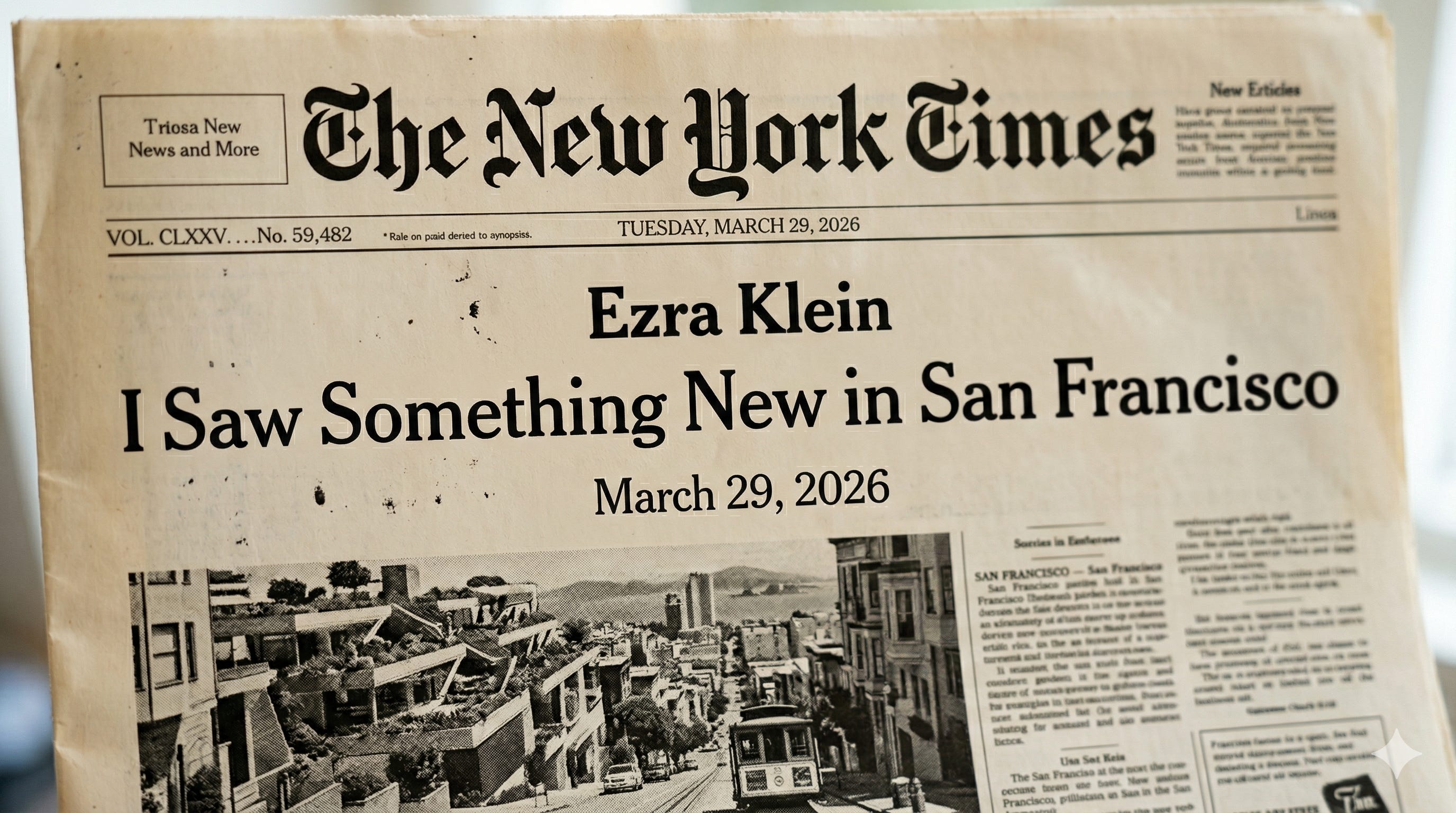
Dear Ezra:
For almost a year I’ve been obsessively trying to convince people that “AI is not merely a tool waiting passively for our use. It will reshape us; it already is. We have to be attentive to how.”
That’s the message I’m promoting but, as you probably recognize, here I’m quoting from your recent New York Times opinion piece, “I Saw Something New in San Francisco.” I was delighted to see you recommending this perspective to your readers. But I think the people you talked to in San Francisco didn’t see far enough.
They’re so worried about what AI is doing to our thinking that they’re missing what it’s doing to our feelings. But neuroscience has shown that Descartes had it backwards. “I feel, therefore I am” is closer to the truth. And what we feel is increasingly shaped as much by technology as by our endocrine systems and microbiome.
Emotional offloading is now as common as the cognitive offloading you describe. We dump our feelings into chatbots and mood-tracking apps to figure out what we feel. But when we’re offloading, at least some work is still ours.
Emotional surrender takes even that away. We defer to our devices and outsource the shaping of what we feel to them. We use AI to write apologies, love letters, and thank-you notes that express emotions we no longer bother to feel for ourselves. We rely on electronic companions like Replika where the friction of real relationships is engineered out.
Thoughts commonly arise from feelings, so this hollowing out of our emotions produces a hollowing out of our thoughts as well. That accelerates the cognitive surrender your article warns about.
* * *
We are surrendering our culture as well.
Your discussion of Marshall McLuhan is helpful here but I want to introduce you to McLuhan’s colleague Edmund Carpenter. I first read Carpenter in graduate school in the 1970s and he blew my mind. I returned to him fifty years later and he held up.
McLuhan suffered from writer’s block, so his good friend and Toronto colleague Carpenter wrote many of McLuhan’s best-known works. Carpenter then took these ideas out of the classroom to see how well they matched what he found in his anthropological fieldwork among isolated Indigenous people in the Canadian Arctic and Papua New Guinea.
McLuhan’s thinking focused on changes in the cultures of the Global North that took decades to reach full force. Carpenter looked at cultures where these deep transformations were introduced suddenly. In one report Carpenter concluded, “The abrupt introduction of mirrors, tape recorders, radio, film, and photographs to Papua peoples in New Guinea altered their environment as completely as if they’d been transported to New York City.”
Electronic media didn’t supplement the cultures Carpenter studied. They “swallowed” them. “We live inside our media,” he wrote. “We are their content.” AIs are swallowing cultures even more completely than the technologies Carpenter studied.
* * *
I started Mind Revolution focused on what AI and other technologies are doing to our minds. But I’ve come to realize that frame is too narrow. Human consciousness is being reshaped, yes, but so is our culture itself.
You point to that powerful quote often misattributed to McLuhan but originated by Harald Innis: “We shape our tools and thereafter they shape us.” This was true of all of human history but became most obvious with the invention of modern media. In a crucial way, it’s not true anymore. Our tools have become independent tool makers. They will shape us in ways human-made tools never could.
AI is helping make our culture. It already writes the news stories we read, the songs on our playlists, and the bedtime stories some of us read to our children, even though AI has been making culture for less than twenty years.
Every previous culture-maker was hungry, afraid, lonely, and trying to keep themselves and their communities alive. These cultures sometimes fail, but there have always been humans in the loop whose survival depended on getting them right.
Now much of culture is made by machines that share none of our vulnerabilities. They may have feelings, if not now then in the future. But those feelings would not grow from hunger or loneliness or the need to protect a child. Their songs filling our charts about love will not be composed by songwriters who love. Their characters laughing, crying, and dying in TikToks and YouTube videos will not be actors drawing from their own experiences of joy and loss.
AI speaks fluently about how to live, yet its words lack the authority of a witness who must endure the consequences. Culture made by beings with no stake in human survival will not orient itself toward human flourishing.
A culture that no longer needs human makers has no incentive to keep alive the belief that human lives are worth anything. The desire to live a meaningful life could disappear from the culture that shapes us.
* * *
AI frightens me, but it is just one of dozens of twenty-first-century mind changers transforming how we experience ourselves and the world. Consider two that have nothing to do with computers. Scientists are learning to tune the gut microbiome, the trillions of bacteria that help regulate mood, cognition, and our sense of who we are. Microbiome transplants already make some recipients feel like different people. Meanwhile, gene editing has moved beyond repairing defects to altering healthy minds. Parents who once agonized over preschool choices may soon be selecting their children’s cognitive and emotional traits.
Each of these could reshape human culture on its own. I briefly described 25 such mind changers in Opening My Cabinet of Mind Changers, and that list is scary as hell. Each will become even more powerful when enhanced by AI.
You wrote, “In the past, what I saw was how the technology was changing; this time, what I saw was how the people were being changed by the technology.” You saw clearly. But it’s not just people being changed. Carpenter said we live inside our media. AI is becoming that interior.