

Our Cosmic Significance
Built from hunger, pain, and the knowledge we die

Without intending to, across dozens of posts I've developed a big picture view of what it means to be human. It’s made me feel better about myself and about these tumultuous times. I hope sharing it may do the same for some other people.
This big picture begins in what physicists call the universe’s four fundamental forces: gravity, electromagnetism, and the weak and strong nuclear interactions. Relations among these four explain everything in the universe for its first nine billion years. Then a fifth force, life, appeared.
Life transforms dead matter into organisms that strive to stay alive. Science still doesn’t understand how this fifth force emerged from non-living forces but the Earth we recognize, with its blue skies and breathable air, is mostly a result of biological processes. Early, simple life forms created the conditions for later, more complex forms. Cyanobacteria flooded the atmosphere with oxygen, a poison to the life that came before, and inadvertently made animal life possible.
A sixth force, consciousness, arose out of life. How consciousness emerges from life also remains unknown, but its power is indisputable. It gives the universe the ability to make meanings and intentionally rearrange matter to achieve future goals.
Machine intelligences signal the emergence of a seventh force. Though they lack life, these machines can, like consciousness, pursue goals and reshape their environment. Life and consciousness could disappear one day while machines we built remain. Intelligent, human-like behavior would continue after our species is extinct.
Homo sapiens emerged around 300 thousand years ago with minds not that different from the other Homo species with whom for a time we shared the planet. What followed were several mind revolutions, each remaking the experience of being human.
The first revolution gave our ancestors speech. Where before there had been grunts and gestures, now there were words, human breath shaped into meaning. People could name things and these names could be handed down across generations. Knowledge and culture expanded as never before.
Nothing spoken survives from so long ago. But people who could name things could also scratch their intentions into stone.
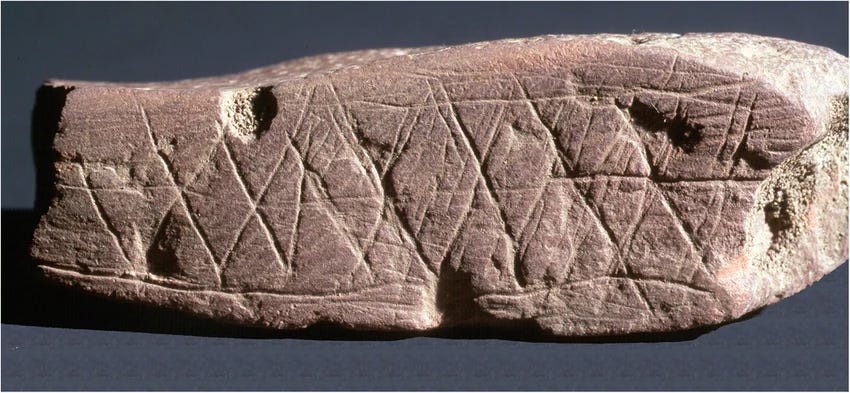
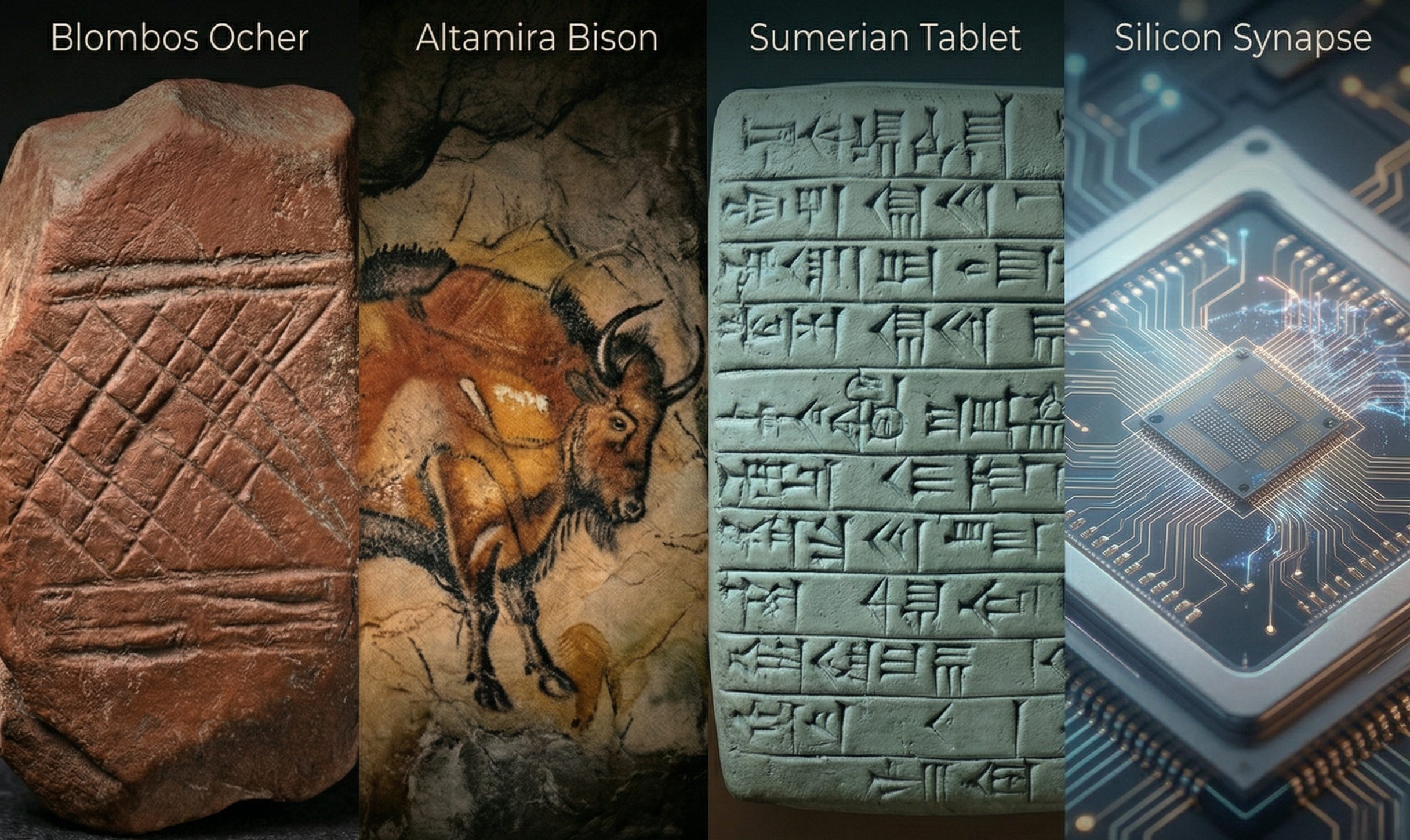
Crosshatch drawing in ochre on stone, Blombos Cave, South Africa, approximately 73,000 years ago. This is not a picture of anything. It is a pattern, abstract marks made with intention, but what that intention was we do not know. Representation, the ability to draw what the eye sees, would require another revolution. This drawing is something earlier, and stranger. A new kind of mind leaving its first marks.
A second revolution, sometimes called “the Big Bang of Consciousness,” arrived roughly 60,000 years ago. Humans learned to imagine what was not in front of them and plan for what had not yet happened. You can see the difference in what they left behind. Patterns became pictures.
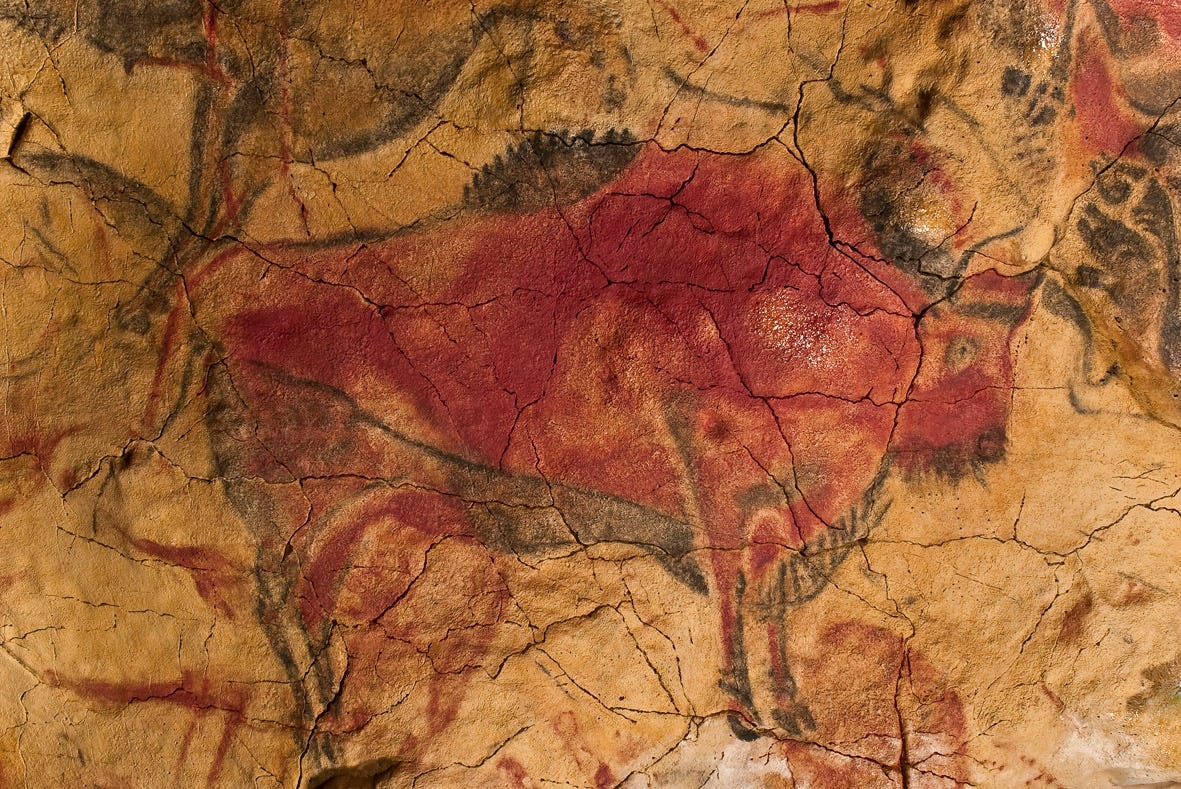
Painting of a bison, Cave of Altamira, Cantabria, Spain, roughly 15,000 years ago. When they were found in 1879, experts declared the paintings forgeries. They could not believe prehistoric people were capable of such work. Their discoverer died disgraced. He was vindicated fourteen years too late. Picasso is said to have declared “after Altamira, all is decadence.” This sophistication was not possible with the first revolution. It required a second transformation, one that gave people imagination and the ability to turn their inner worlds into art.
A third revolution less than 10,000 years ago gave thought a physical home outside the body. Ideas before had vanished with the breath that carried them. Now they could be written on clay, papyrus, and paper. Thoughts outlasted their thinkers, and sometimes outlasted entire civilizations. We still read words set down thousands of years ago in languages no one speaks. Some of these words guide how billions of people live.
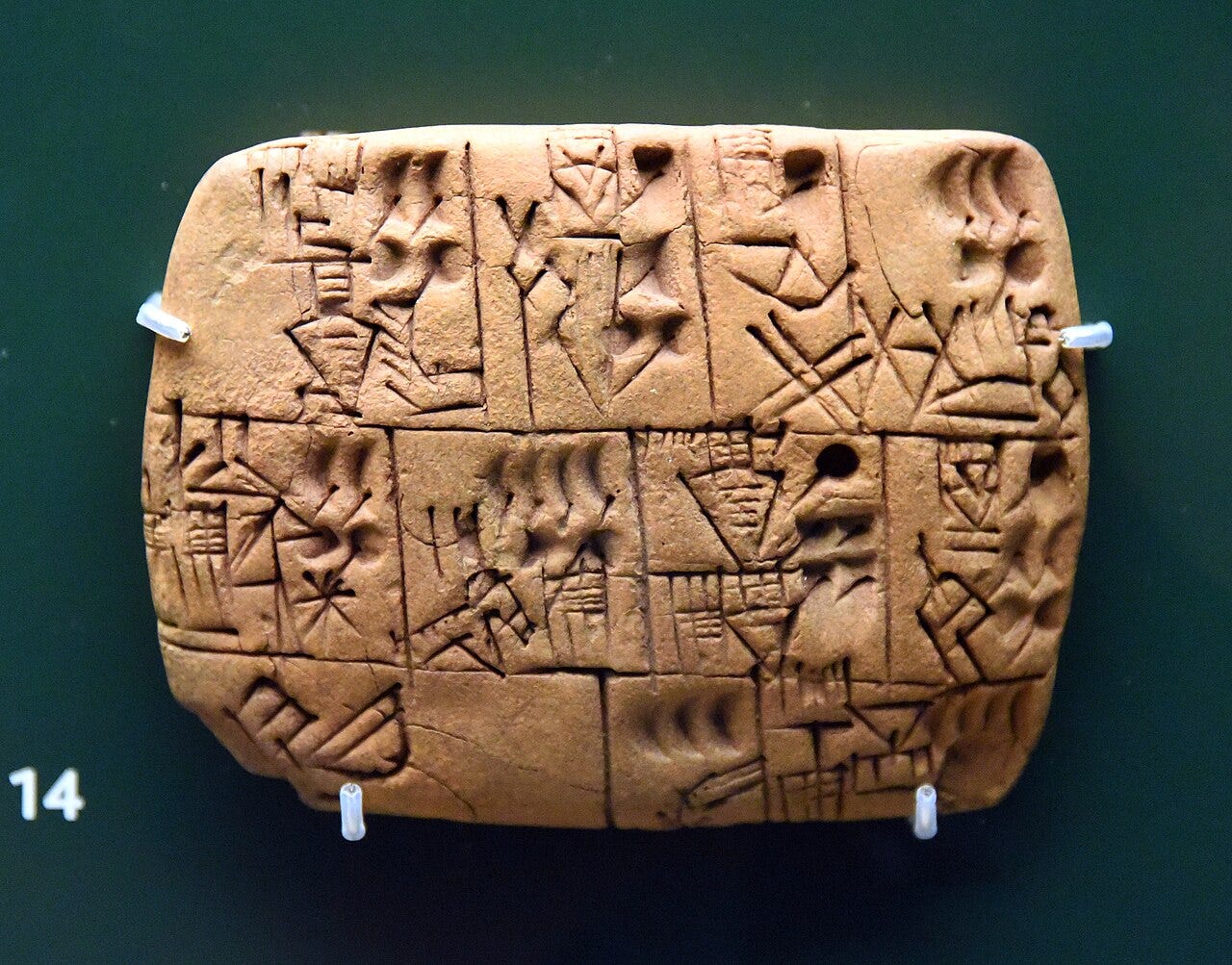
Sumerian clay tablet, approximately 3100 BCE. A record of beer rations. The first writing was not philosophy or prayer. It was bookkeeping, a tool built by vulnerable people trying to manage their survival. It also made possible what no previous revolution could: the organization of thousands and eventually millions of people into shared societies, and the development of science, which would one day produce a fourth mind revolution.
These revolutions in consciousness changed more than what people made. They also changed what it felt like to be alive. Before the first revolution, a mother could pull her child away from a snake but little more. After it, she could tell him that the red ones kill and the brown ones don’t. Tens of thousands of years later, a mother could plan two routes to water in case the big cats were hunting near the first, and lie awake unsure if she’d chosen right. Less than ten thousand years ago, a mother could read about children that had died from snakebite in a country she would never visit.
Today, as a fourth revolution in consciousness begins, an algorithm can monitor her child and tell her when to worry. Her instincts may say one thing and the algorithm another. We’re no longer sure which to trust.
We can take comfort in knowing that humans survived and even flourished in the aftermath of the previous mind revolutions. But this new revolution is different.
The earlier revolutions were made by people who had much to lose. They developed speech to coordinate hunts and protect themselves from predators. Storytelling and imagination let them see beyond what was in front of them and plan for what hadn’t happened yet. They created ever more complex writing systems that enabled ever more complex societies.
In every case people felt the pressure of their vulnerabilities. They feared death, needed food, and depended on others for survival and comfort. Those needs didn’t just shape what consciousness became. They are what forced consciousness into existence. Consciousness is how vulnerable creatures manage what threatens them. Now machines that do not share human vulnerabilities are shaping consciousness too.
The algorithm that monitors a child cannot fear the child will die. It assesses danger without facing danger, processes grief without grieving. It is the first participant in the history of consciousness to have nothing human to lose.
Those earlier revolutions happened to us, their consequences realized only in retrospect. We are building this new one ourselves. And we are building it alongside machines that will never need what we need.
It took the universe nine billion years to produce life and billions more to produce a living thing that knew it was alive. I have long believed this is what makes us cosmically significant, rare, and precious. We are the universe knowing itself. Our rarity is real, but I understand now that’s not the deepest reason we’re worth protecting.
The deepest reason is our vulnerability. Vulnerability is not a weakness consciousness carries. It is the reason consciousness exists.
The mother lying awake, unsure if she chose the right route to water, is experiencing consciousness at its source.
Human consciousness did not develop in spite of mortality, need, and attachment. It developed because of them. The universe knows itself through us because we are people who need to know, who think because thinking keeps us alive.
Each of the first three revolutions expanded what vulnerable minds could do. The fourth might replace our minds entirely. If it does, the universe may not go silent. Machines could keep thinking and planning. But minds made from our particular vulnerabilities, the knowing that arose from hunger and fear and love, will be gone. And nothing that replaces us will miss what we were.
AI is magnificent the way stars are, the way all of nature's fundamental forces are. When I look up on a cloudless night I see that magnificence everywhere, countless stars burning without fear of burning out.
But our magnificence is different in kind, a magnificence built from the fact that we can be hurt. Hunger, pain, and the knowledge that we will die are not flaws in the design. They are the design.
What I feel so often as personal failure, as not having made the right choices, is life itself pressing me forward.