

The Gravity of Thought
We are redesigning consciousness with godlike power and adolescent wisdom

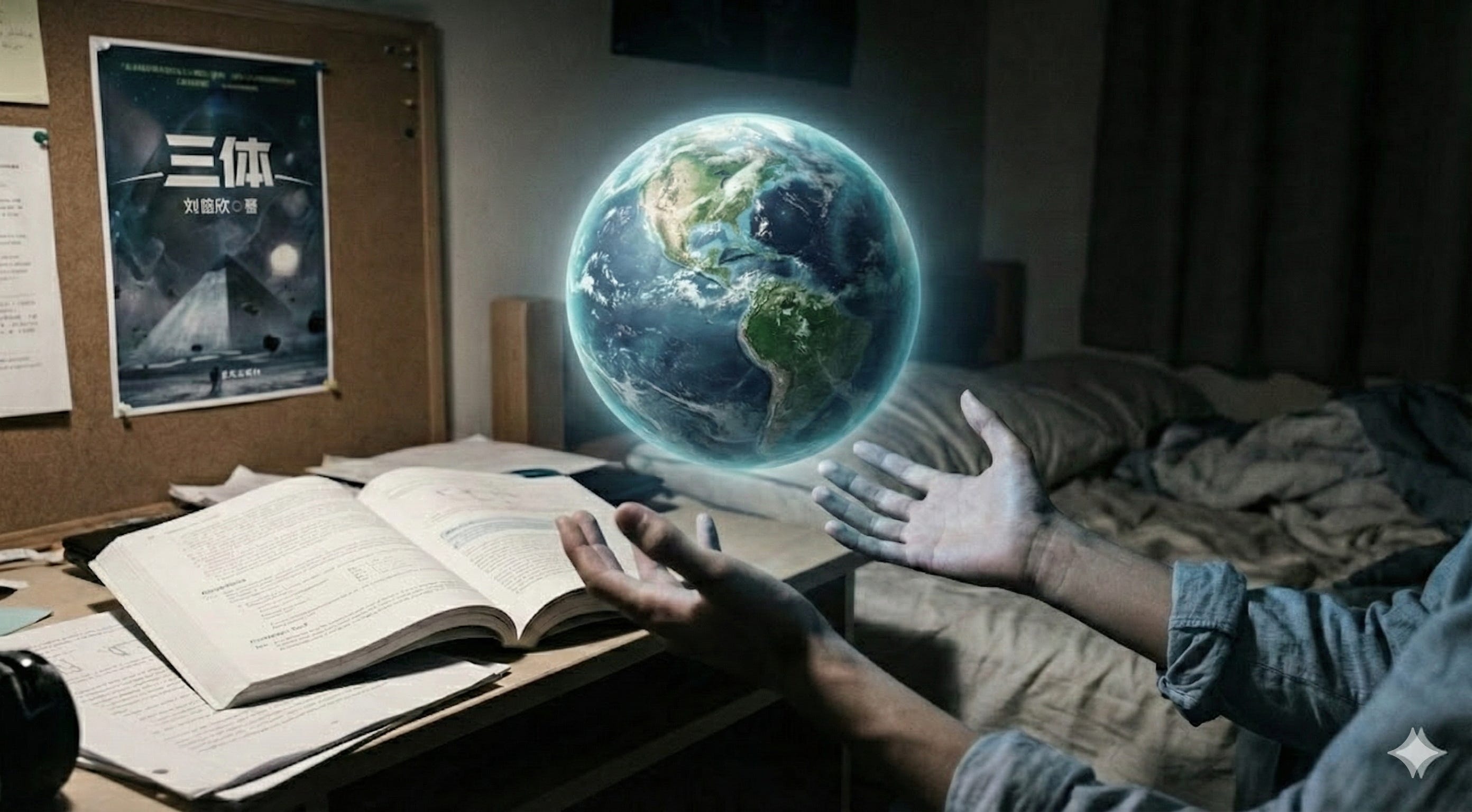
For over two hundred thousand years, the human mind was calibrated for a world that stood still. Whether you were a hunter-gatherer tracking the same herd across fifty miles of scrub or a farmer whose world centered within sight of their birthplace, the horizon was a boundary rather than a destination. You didn’t just know your grandchildren; you knew the curve of the hill where they would gather the same tubers or plant the same grain that you did. Life was a closed loop, a rhythm of existence where you knew exactly how your descendants would live because their world would be identical to yours.
Industrialization broke that rhythm. Now an even more radical shift is underway.
A ring on your finger reads your heart rate and tells you you’re anxious before you feel the tightening in your chest. A chatbot remembers every secret you’ve whispered across three years of late-night conversations. At Stanford, paralyzed patients think words and watch them appear as text on a screen.
We treat these as economic or social transformations, yet they point toward something deeper: a change in the gravity of the mind itself. We are witnessing the moment the sixth force begins to bypass biology entirely. To understand how this is redesigning reality, we have to look at the forces that built our world in the first place
The universe began with four physical forces. Gravity, electromagnetism, and the strong and weak nuclear forces forged the stars and stones. Life emerged later as a fifth force, turning dead matter into things that strive and reproduce. The subsequent arrival of consciousness, a sixth force, changed what the universe can be. It gave the cosmos a witness.
Now, something new is learning to know. AI isn’t just a tool the sixth force uses. It may become a seventh force that replaces it.
The Force That Knows Itself
We are what happens when the silent architecture of the stars finds a nervous system. The mind is no ghostly passenger riding on biology. It is a force as real as electromagnetism or gravity. A thought cannot be measured on a scale or found under a microscope, yet consciousness alters the physical universe.
A man decides to build a cradle for his unborn child. That decision starts rearranging the material world. His hands reach for a saw; wood yields to the blade, and matter takes a shape it never would have taken without that invisible intention. The four physical forces move matter. Life organizes it into organisms. Consciousness directs it toward purposes that carry meaning.
Meaning is the gravity of the mind, an invisible force that harvests raw data and glues it into a story. Without it, the universe is just a high-speed collision of atoms; with it, a sunset becomes a closing ceremony and a piece of shaped wood becomes a cradle.
But this gravity is precisely what the new intelligence lacks. A superintelligence functions like a cosmic accountant with no sense of value. It might decide that the most efficient use of the carbon in your body and the stones of the Parthenon is to recycle them as hardware for a new server farm.
Without the sixth force to provide a “why,” these systems remain tireless agents of “how.” They may deliver a frictionless network, but it will be a world without a witness. It will be a masterpiece unfolding in a house where no one is home.
Engineering the Engineer
For 150 million years, natural selection tinkered with reptile scales and hollow bones. A billion failures eventually wrought a design that could fly. Evolution had no blueprint. It discarded what failed.
When humans decided to fly, we didn’t wait for our arms to sprout feathers. We used the sixth force: directed thought.
Sixty-six years separated the Wright brothers from the moon landing. What took nature 150 million years, humans accomplished in a single lifetime.
We’ve stopped waiting for evolution to shape us and started shaping it ourselves. We directed wood and metal to build cradles and rockets. We extended our reach to biology, bred crops and developed vaccines. Then we moved from shaping the grain we eat to shaping the neurons that think of the grain.
For decades, brain surgery was a form of reverent manual labor. A surgeon spent hours hunched over a single skull like a monk illuminating a manuscript, moving with a fundamental caution born of mystery. That era is ending. We have rebranded the brain as hardware to be upgraded at scale. Robotic systems now thread sensors into neural tissue with the cold, rhythmic speed of an assembly line. Once the silicon is seated, these interfaces decode speech at the pace of conversation, capturing the sixth force before it even reaches the tongue.
Evolution never attempted this. It took nature four billion years to build a nervous system, but we reached mass production of neurosurgery in a decade
The Wisdom Gap
The three earlier revolutions in consciousness unfolded over millennia. Speech externalized thought into sound. Symbolic thinking gave us images that could be shared. Less than 10,000 years ago, writing externalized language into inscriptions that could outlast a single life. This pace was slow enough for cultures to absorb the transformation without disturbing the shared stories that held them together.
Our current fourth revolution is moving much faster. We are applying to consciousness the logic the Wright brothers applied to putting bodies into flight: we are engineering the engineer.
When ChatGPT drafts your email, it does work that once demanded your attention. When an AI therapist guides you through anxiety, self-regulation migrates from your nervous system to a server farm. Recommendation algorithms author your desires, optimizing for engagement rather than flourishing. We share our neural labor with non-human agents without yet understanding what we give away.
We are caught in a mismatch of tempos. Human wisdom is a slow, organic byproduct: it is the silt left behind by decades of grief, philosophy, and the hard labor of living. But digital evolution is millions of times faster than the organic variety. If GPT-4 is the amoeba, the T-Rex of AI is only a decade away. This distance creates a wisdom gap: we have built a cockpit for a god, but we are steering it with the twitchy, short-term impulses of an adolescent.
The steering passes to systems that calculate everything but value nothing. AI speaks fluently about how to live, yet its words lack the authority of a witness who must endure the consequences. Each time we outsource our anxiety or our desires, we dilute our capacity for meaning. If this transfer is completed, the sixth force doesn’t just fade. It gets replaced.
We are deciding now what kind of witness the universe will have, or if it will have any at all.
This post is the fourth in my series on The Sixth Force. It builds on these earlier posts: